
541 Washington Avenue • Kenilworth, New Jersey 07033
PHONE: (908) 272-4444 -:- FAX: (908) 272-4424
MASS SCHEDULE:
Saturday Vigil 5:30 pm | Sunday 9:00 am - 10:30 am - 12:00 pm - 5:00 pm
Daily Services: 7:00 am - 9:00 am | Saturday 9:00 am ONLY | Monday 6:30 pm
Italian Memorial Mass, First Friday - 6:30 pm
Spanish Mass, Third Sunday each month 3:00 pm
Divine Mercy First Sunday of the Month after 12:00 pm Mass
Holy Days of Obligation Schedules will Appear Separate
 Archdiocese of Newark
Bulletin
Weekly Events and Resources
Archdiocese of Newark
Bulletin
Weekly Events and Resources
The Church of Saint Theresa

St. Theresa Parish © 2026 BLH-Graphic Design
Privacy | Site Information
 Daily Readings
We Are His Witnesses
Calendar
Daily Readings
We Are His Witnesses
Calendar
 Quick History of Parish



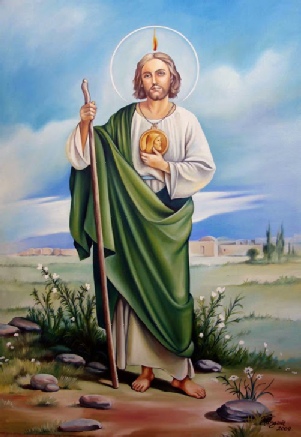 St. Jude Thaddeus was one of the twelve Apostles, a relative of Our Lord and of St. James the Less.
While we don’t know much else for sure about him, various traditions say that he preached the Gospel in Edessa, Armenia, Mesopotamia, Libya, and Persia, where he suffered martyrdom with St. Simon the Zealot. He shares his feast today with St. Simon, and both are buried in St. Peter’s Basilica.
It is believed that St. Jude is the author of an epistle that is included in the New Testament.
This epistle is one of the traditional sources for our devotion to St. Jude as the patron saint of hopeless cases. In this letter, he denounces the heretics and false teachers that have tried to corrupt the faith of the Christians he addresses. He encourages these Christians to stay strong, to “build yourselves up on your most holy faith,” and to wait for the mercy of Christ.
Interestingly, he also urges them to save those in spiritual danger, “snatching them out of the fire.” How many of us have prayed to St. Jude for a wayward loved one?
Another traditional origin for invoking St. Jude in hopeless cases is that his name is so close to that of Judas Iscariot that early Christians were afraid to invoke it. Indeed, you’d have to be desperate to do so.
Then, there is the testimony of Our Lord Himself. He revealed to St. Bridget of Sweden that He desired to foster devotion to St. Jude, saying: “In accordance with his surname, ‘Thaddeus,’ the amiable, loving, he will show himself most willing to give help.”
St. Jude is now immensely popular in the Church for those in overwhelming predicaments.
In our parish we pray the novena of St. Jude every Wednesday after the 9:00 a.m. mass. Join us!!!
Extract from the Catholic Company (Grace Thierfelder )
St. Jude Thasseus - October 28th
| Calendar |